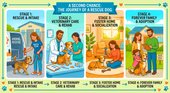
The Challenges and Rewards of Dog Fostering
Most people who have fostered a dog will tell you, when asked, that it's one of the best things they've done. Most of them will also tell you, if you ask the follow-up question, that there were days when they weren't sure they were cut out for it. Both of these things are true simultaneously, and the relationship between them — the way the difficulty and the meaning are often inseparable — is what makes fostering such a distinctive experience.
Understanding both sides honestly, before you begin, is how you prepare for the reality of it.
The Challenges Are Real
Let's start here, because fostering is sometimes romanticized in ways that don't serve the people considering it or the dogs who need them to succeed.
The behavioral and medical reality. Many rescue dogs arrive carrying the effects of their past — fear, uncertainty, under-socialization, or the physical consequences of neglect. Housetraining that seemed to be progressing can regress without warning. Separation anxiety can make ordinary daily routines complicated. Reactivity on walks, resource guarding, fear of specific triggers, or the need for medical management of ongoing conditions — these aren't rare edge cases. They're common features of rescue dog care, and they require time, patience, and the resilience to keep showing up even when progress is slow.
The time and energy commitment. Fostering isn't adding a decorative presence to your home. It's caregiving — with all the walks, training sessions, vet appointments, socialization work, and communication with the rescue organization that implies. This can stretch schedules, strain personal time, and occasionally test relationships within a household that didn't fully anticipate what "temporary foster dog" would actually look like on a Tuesday evening when everyone is tired.
The goodbyes. This is the one that surprises people most reliably, even when they were told to expect it. You bond with the dog — genuinely, fully, in the way that happens when you're paying close attention to a living creature every day. And then the adoption comes through, and the dog leaves, and the house is quiet in a way that has a specific emotional texture that's hard to describe until you've experienced it. The grief is real even though the outcome is good. Some people find this part manageable. Others find it the hardest thing they've ever done with an animal.
The uncertainty of outcomes. Not every fostering situation ends neatly. Some dogs need to be returned to the rescue because the placement isn't working. Some adoptions fall through. Some dogs have behavioral complexity that exceeds what the foster family can handle alone, regardless of how much they care. Fostering requires a tolerance for situations where effort and love don't produce a clean, satisfying resolution — and the emotional skill to sit with that without interpreting it as failure.
The Rewards Are Equally Real
If the challenges were the whole picture, nobody would foster twice. The reason so many people do — the reason experienced foster families describe it as one of the most meaningful things in their lives — is that the rewards are genuinely substantial.
The transformation, witnessed firsthand. This is the one that gets people. A dog arrives uncertain, possibly shut down, holding their body in the careful way of an animal that has learned not to trust easily. And then, over days and weeks, that changes. The first time they approach you voluntarily rather than waiting to be approached. The first genuinely relaxed sleep. The morning they greet you at the door with real enthusiasm rather than cautious hope. These moments hit harder than most people expect because you know exactly what the distance was — because you were there for the whole journey from one end to the other.
The knowledge of specific, traceable impact. There's a particular quality to knowing that your actions directly changed the trajectory of a specific life. Not in an abstract "I donated to a good cause" way, but in a concrete, this-dog-is-in-a-loving-home-because-I-opened-my-door-six-weeks-ago way. That knowledge is durable. The foster families who have helped dozens of dogs over years carry it cumulatively, and it compounds into something that feels genuinely meaningful rather than incidental.
The personal growth that happens quietly. Fostering tends to build things in people — patience, emotional resilience, the capacity to sit with difficulty without needing it to resolve immediately. Working with a dog whose history requires careful, sustained attention changes how people approach problems more broadly. The tolerance for slow progress, the skill of reading non-verbal communication, the practice of showing up consistently even when results aren't immediately visible — these don't stay contained to dog-related situations.
The community that comes with it. Fostering connects people to a network of other people who share the same values and the same specific experience: the volunteers, the rescue coordinators, the fellow foster families, the adopters who reach out months later with updates. These connections have a warmth and depth that comes from shared purpose, and many of them become genuinely lasting friendships.
The Hard and the Good Are Often the Same Thing
The most honest insight about fostering is this: the challenges and the rewards are frequently two expressions of the same underlying fact.
The attachment that makes the goodbye painful is the same attachment that made the care so effective. The dog who benefited most from your fostering was almost certainly the one who required the most of you — who was hardest in the beginning and therefore most transformed by the end. The grief you feel when a dog leaves is proportional to the love you gave, which is proportional to the difference you made.
Experienced foster families tend to describe a shift that happens somewhere after the first few placements: the goodbye doesn't stop being hard, but it stops being only hard. They've accumulated enough evidence of what the difficulty was for — enough dogs who landed in wonderful homes, enough progress they witnessed firsthand — that the grief of letting go coexists more comfortably with the satisfaction of having done the right thing.
Getting to that place requires a few practical things alongside the emotional ones. Setting realistic expectations before a placement begins — about time, energy, and what the household can genuinely handle — makes the middle sections more manageable and prevents the kind of overwhelm that leads to early returns. Communicating openly with the rescue when something isn't working isn't an admission of failure; it's how placements stay healthy for everyone, including the dog. And allowing yourself the space to actually feel the goodbye — rather than rushing past it into the next placement before the previous one has been processed — turns out to matter for long-term sustainability.
What Fostering Is, Honestly
Fostering is caregiving with a time limit, an uncertain outcome, and a guaranteed goodbye. It's also one of the most direct, tangible, personally felt forms of contribution to the rescue world that exists. Every foster home is a dog's best chance between the place they came from and the place they're going — and the people willing to be that, knowing the full cost of it, are doing something genuinely valuable.
Hard in the best way. That's how most fosters describe it. And most of them are already thinking about the next one before the current one has even left.